Tag: diversity and equity

Witnessing Softness In Black Women

We rarely talk about softness when we talk about Black women.

We talk about her strength.

We talk about her leadership.

We talk about her resilience.

Yet softness may be one of the most sacred parts of her humanity. ( I explore this topic more in the Deciding To Soar podcast. You can listen on YouTube. It’s also available on Apple and other platforms.)

Let’s be clear….

Softness is not fragility. It is not weakness. It is not a lack of resolve.

Softness is a Black woman’s capacity for tenderness, empathy, levity, and joy without the burden of wearing armor.

And softness matters because no one is meant to survive on strength alone.

Yet culturally, there is an unspoken expectation that Black women should do exactly that — survive alone.

That is why Black women are praised for their strength, resilience, and unshakability.

But over time, those adjectives become a prison.

Inside that prison, her softness is overlooked because the world grows accustomed to her endurance.

Her tenderness is ignored because her competence is mistaken for invulnerability.

Her need for care is dismissed because she handles things “so well.”

And sometimes she is stretched, tested, and even attacked because her ability to withstand pressure is misinterpreted as invincibility.

But when her softness goes unwitnessed, there is a cost.

Exhaustion becomes normalized.

Boundaries are crossed.

Rest is reframed as indulgent.

Vulnerability is misread as deficiency.

Over time, she armors herself — not because she lacks softness, but because the environment does not feel safe enough to hold it.

Even though the world may call her protective response resilience, it isn’t.

It is survival, and survival is not the same as thriving.

Softness!

It is NOT a reward for endurance.

It is not care extended only after “performing” excellence.

It is not gentleness extended only after enduring hardship.

Softness is a right, a birthright.

It is where her nervous system settles. Where healing begins. Where wholeness is restored.

And softness is where growth happens because REAL growth can’t happen under constant pressure.

It happens in environments of safety, respect, & care.

My friend, softness is fertile ground.

It is where creativity returns.

Where imagination expands.

Where new versions of herself are allowed to emerge and bloom.

The blessing is, when Black women are allowed to be soft, they do not shrink; they expand.

And their expansion strengthens families. Stabilizes communities. Elevates organizations. Contributes to the world.

That’s why witnessing her softness is not sentimental.

It’s strategic.

It’s healing.

It’s liberating.

It’s an act of respect.

An act of honor.

A sign of leadership.

Strength may be what the world demands of her, but softness is what sustains her.

This Black History Month, may we “witness” Black women not only for what they produce or survive, but also for what they feel, hope for, and need.

And may we build workplaces where their strength is appreciated, and softness is protected.

Blessings!

P.S. – I share more in my newsletter. Subscribe here. 

Seven Lessons on Overflow, Contemplation, and Sacred Sisterhood

There are seasons in life when something in you whispers, begin.

Recently, I recorded my first interview on Deciding to Soar: Living Life Your Own Way. It was not perfect. It was unscripted. It was unedited. It was human. And I did it anyway.

Why?

Growth does not require perfection. It requires progression. And progression requires motion because we learn as we go and as we do.

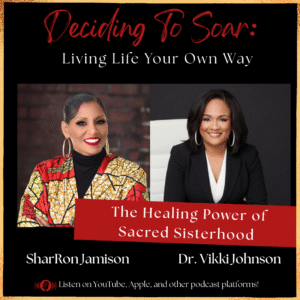
And for that, I am deeply grateful that Dr. Vikki Johnson was willing to walk with me in that imperfect beginning. Thank you, Dr. Vikki. (You can learn more about Dr. Vikki Johnson at her website. Click here.)


In my soul-nourishing conversation with Dr. Vikki Johnson, we explored seven deeply layered themes that speak to women navigating midlife, career transitions, contemplation, and personal evolution.


1. Operate From Overflow, Not Capacity

Vikki shared a story her grandmother taught her about a coffee cup and saucer. Her grandmother would pour her coffee into a cup, and when it spilled into the saucer, she would drink from the saucer first. Her grandmother explained: What is in the cup is for you. What spills into the saucer is what you give away.

This illustration is more than charming nostalgia. It is an instruction.

We are often conditioned to give from our cup — to meet the needs of others before meeting our own. But nourishment is not selfish; it’s sacred. It is vital to our well-being, wholeness, and wellness.

When we give from a place of depletion, resentment grows. When we give from overflow, generosity feels natural.


2. Contemplation Creates Liberation

Contemplation is not laziness. It is courage.

It is sitting still long enough to ask:

  • Who told me that?
  • Is this belief mine?
  • Is this aligned with who I am now?
  • Is that perspective edifying?

Inquiry is the birthplace of freedom. We cannot liberate ourselves from inherited narratives, stereotypes, and cultural conditioning unless we first question them.

We must think deeply to move freely.


3. Evolution Requires Release

Growth and grief walk hand in hand because evolution requires release.

We may grieve:

  • Old identities
  • Familiar environments
  • Roles we once held
  • Rules we used to follow
  • Relationships we have
  • Versions of ourselves that once felt safe

Grief does not mean we are wrong. It often means we are expanding.


4. Peace Is Practiced

Peace is not accidental. It is intentional.

It requires boundaries. It requires restraint. It requires choosing not to respond, not to overextend, not to internalize what is not ours.

Peace must be protected by YOU!


5. Values Govern Our Lives

Dr. Vikki spoke about the importance of identifying core values.

When we know what truly matters to us, our values govern our decisions. They shape our yes and our no. They help us set boundaries. They reduce our susceptibility to seeking validation from others.

When you are aligned with your values, you move differently. You do not chase approval or acceptance. You walk in integrity, even if it means walking alone.


6. Covenant Relationships Sustain Growth

Not all relationships are covenantal.

Covenant relationships are rooted in integrity, safety, and witnessing. They allow space for imperfection, evolution, and truth.

We need people who can mirror our growth without envy and hold our complexity without judgment.

Sacred sisterhood is sustaining.


7. Begin Before You Feel Ready

This episode itself is evidence: perfection is not the prerequisite for purpose.

Progression requires motion. And motion teaches what preparation alone cannot.

If you are in midlife, reimagining your career, or quietly becoming someone new, begin.

You will refine and pivot along the way.


If this message resonates with you, please share it with someone who may need it. Growth multiplies when wisdom is passed forward.

Also, I invite you to subscribe to my YouTube channel. Your subscription helps me continue building a platform rooted in authenticity, sisterhood, and purpose, which allows me to create more meaningful conversations and programming for people navigating transition and transformation.

And if you are not yet subscribed to my newsletter, I encourage you to join. It’s where I share deeper reflections, resources, and insights that may support you in your becoming.

Let’s stay connected. Let’s continue to dare to soar higher — together.

Blessings!

SharRon

Do You See Us? The Healing Power of Witnessing Black Women

Last week, I began a series on the power of witnessing.

Based on the feedback I received, it resonated deeply. Many of you shared that it named something you’ve been feeling—at work, in leadership, and during seasons of transition and uncertainty—something you hadn’t quite had language for.

So today, I want to continue that conversation, with the hope of supporting all of us in our efforts to build more loving, affirming, and supportive communities.

And before I go any further, I want to again define witnessing for anyone who may be joining us for the first time.

Witnessing is not simply noticing someone’s presence.

To witness is to:

  • see truth clearly
  • and testify to it out loud

When you witness someone, you are saying:

I see what you can do, and I value who you are.
I recognize your humanity, even if the world does not.
I honor your contribution, even if it goes unrewarded.
I remember you, even when history or leadership tries to forget you.

Remeber, witnessing isn’t about applause. It’s not a symbolic celebration or surface-level praise.

Witnessing is about seeing people and their realities clearly—and responding with care.

As we enter Black History Month—a time to honor the lives, legacies, and contributions of Black people—I want to pause and speak with intention, especially to Black women, as we continue the conversation I began last week.

Although many of us are navigating job loss and career uncertainty, research consistently confirms that Black women are experiencing higher rates of job loss, greater financial instability, and more frequent career transitions than any other demographic group.

Unfortunately, I have seen this play out in boardrooms, ministries, and community spaces alike, where Black women continue to execute strategies, solve problems, and steady institutions even as their own job security and financial stability are threatened.

In moments like this, witnessing is not optional. It is vital to nourish the soul and support a person’s dignity.

And as we all endeavor to witness each other in confidence-building and dignity-affirming ways, I want to share five specific ways we can witness Black women—ways that protect humanity, interrupt erasure, and support healing.


1. Witness Their Strengths (Talent, Skills, and Expertise)

When we talk about witnessing the strength of Black women, we are not only talking about emotional endurance. We are also talking about talent, expertise, insight, wisdom,  creativity, and skill.

Witnessing here means naming what Black women do well—how they think, lead, solve problems, create, and elevate both the work and the people around them.

Why this matters:
When talent and expertise are shared without care, acknowledgment, or appreciation, it can feel like exploitation. Over time, that exploitation can feel like extraction and usury.

Also, being constantly relied upon for what we do well—without being rewarded—undermines confidence, squashes potential, and discourages continued contribution. It breeds resentment, leads to exhaustion, and discourages participation.

What witnessing strengths can sound like:

“I see how talented you are in this situation.”
“You are an effective writer and leader, and your creativity elevates this work.”
“Your expertise is shaping the outcome in meaningful ways, and I want to name that.”


2. Witness Their Success

Black women continue to achieve success (based on their own definitions and own terms)  despite systemic barriers, unequal access, and constant scrutiny. Yet that success is often minimized, delayed, denied, erased, or credited elsewhere.

Witnessing success means naming achievement clearly, without qualification or minimization. It means acknowledging that Black women have achieved, overcome obstacles, and made sacrifices to accomplish their goals.

It is also a recognition that their success often came at a high emotional, physical, and spiritual cost.

Why this matters:
Over time, failure to witness success teaches society to discount, disrespect, and deny the contributions, inventions, and impact of Black women. It also teaches Black women to shrink instead of shine and to minimize the ways they transform the world.

What witnessing success can sound like:

“Your success is not accidental. It reflects your leadership, skill, and persistence.”
“You are a difference maker, a game changer, and a trailblazer. What you have accomplished on your own terms serves as a model for women coming behind you.”
“I appreciate you and I am deeply inspired by the sacrifices you made and the business you created to support young people.”


3. Witness Their Struggle

Black women are frequently expected to perform without pause, to handle crisis without acknowledgment, and to absorb emotional, spiritual, and relational strain without relief.

What is often unnamed is this: the ability to navigate chaos, complexity, and crisis comes at a cost.

Managing complexity, navigating chaos, and juggling mutiple responsibilities takes an emotional, spiritual, and physical toll on the body, mind, and soul. And these tolls frequently go unnoticed and unnamed until they manifest as exhaustion, illness, or disengagement.

Why this matters:
Unwitnessed struggle leads to burnout—not because of a lack of resilience, but because of prolonged invisibility, lack of support, lack of protection, and unmet care.

What witnessing can sound like:

“I see how much this has required of you.”
“What you’re carrying has weight.”
“Even though it looks easy,  I know that it is hard and feels heavy.”


4. Witness Their Sadness

Sadness is often overlooked because strength is expected. That expectation is reinforced by historical narratives that normalize Black pain and mythicize Black endurance. Both do Black women a profound disservice.

There is also shame attached to sadness, grief, and depression. In some cultures, vulnerability and transparency are even misread or misunderstood as weakness, which further increases feelings of shame and isolation.

Why this matters:
Sadness that goes unseen turns into sickness. And sickness eventually erodes well-being, wellness, and wholeness.

What witnessing can sound like:

“You don’t have to be strong right now.”
“Your feelings are real, and they matter.”
“The situation is heavy and draining.  You are not flawed for feeling it.”


5. Witness Their Shifts

Witnessing shifts means affirming that change is allowed and welcomed.

It means understanding that growth should be supported—not punished or penalized.

The truth is: emotional/spiritual healing, establishing boundaries, and making new choices will disrupt family dynamics, alter relationships, and change access to people who demand older versions of ourselves. In fact, making self-enriching and self-affirming decisions can feel threatening to people who benefited from us deprioritizing our needs, de-centering our wants, and denying our true identities.

Why this matters:
Shifts without affirmation can feel destabilizing rather than liberating. People need to know they are permitted, encouraged, and celebrated as they evolve.  Our transformation should be honored. Our growth should never cost us respect, belonging, or safety.

What witnessing can sound like:

“I see how you are changing, and I honor the courage it takes to choose yourself.”
“I see how you are growing—and your growth inspires me to grow too.”
“I see how you move differently now, and by watching you, I’m learning how to honor myself more.”


This week, I released a podcast episode titled: “Do You See Us? The Healing Power of Witnessing Black Women.”

In it, I explore these five ways of witnessing more deeply—why they matter, how they heal, and how they protect dignity and interrupt erasure. You can listen on Apple, YouTube, or your platform of choice.

I invite you to listen. I invite you to reflect.  Most of all, I invite you—especially during Black History Month—to seek out opportunities to witness Black women and to allow yourself to be witnessed by people who truly value you.

Remember, Black women do not need to be fixed. They need to be WITNESSED! They need to be protected, appreciated, and affirmed.

This week, ask yourself:

  • Who is a Black woman in my life whose humanity I MUST witness more fully—starting today?
  • What might I, as a Black woman—or as a loving human—do to witness myself more fully?
  • How can I witness the unique realities of others in more life-enriching, soul-nourishing ways?

*If this message resonates and you find yourself longing to be seen, affirmed, and held in a thoughtful space, I want to extend a personal invitation.

In March, I’ll be offering a small-group witnessing experience—a guided, intimate space designed for reflection, truth-telling, and soul-centered support.

  • The group will include up to five women.

  • I also have two openings for one-on-one work for those who desire more personalized support.

If you’re interested in joining the group or learning more about working with me individually, please email me directly for details. I would be honored to walk with you during this season.

Sending you blessings as I witness you,
SharRon

You Don’t Need To Do More Work. You Need To Be Witnessed.

One of the most important lessons my elders taught me in my early twenties was this:

You don’t need to do more work. You need to be witnessed.

They were not discouraging excellence or effort.

They were challenging a dangerous assumption that performance and labor alone guarantee elevation.

They understood something many of us eventually learn the hard way: that some people will be expected to carry more, prove longer, and work harder—even when they are already doing excellent work. They knew that exemplary performance alone does not always lead to protection, recognition, or advancement.

That’s why they said, you need a witness.

The word ‘witnessing’ is one we often hear in religious and spiritual spaces. At its core, it means to see truth and to testify to it. Which means that a witness is not a casual spectator or a passive observer. It is someone who names what they see and allows that truth to shape trust, inspire growth, and expand potential.

This is why witnessing matters just as much in workplaces and organizations as it does in spiritual settings.

And to be clear: witnessing is more than feedback. Feedback evaluates performance. Witnessing affirms personhood.

Witnessing says, I see you. I see what you bring. I see who you are becoming—and I’m willing to name it.

If you pause and think about your own career, you likely remember moments when you felt witnessed.

  • Moments when you were invited to the table and trusted to speak.
  • When your growth was not only celebrated but compensated.
  • When people appreciated your work and your wisdom.
  • When you felt visible and valued.

Feeling seen and appreciated had a real impact on your life. It nourished your soul. It built your confidence. It freed you to contribute at the highest level—not out of fear or over-functioning, but out of trust and belonging.

And most of us also remember the times when we were not witnessed.

  • The seasons when we were told that we were reliable, but never considered ready.
  • When we were asked to carry the load, but not given the opportunity to lead.
  • When we were expected to produce, but never promoted.
  • When you had to deliver big results with few resources.
  • When our work was used, but we were never credited.

Those experiences didn’t just stall our careers. They left hurtful marks on our spirits. And over time, feeling unseen or undervalued depleted our energy, eroded our trust, and lowered our level of engagement—not because we lacked resilience, but because we felt extracted from rather than affirmed and invested in.

What I know for sure is this: witnessing matters especially now.

Why?

Many of us are navigating seasons of transition, uncertainty, and reinvention. And while witnessing may not directly address the emotions that come with change, it does something just as important: it reminds you who you are.

It reaffirms strengths that may have been overshadowed by loss, disruption, or disappointment.

 It stabilizes your identity when everything around you feels unstable.

And, it anchors you in truth while you discern your next step.

That’s why witnessing is not a luxury or a soft leadership concept. It is a difference maker. It is a leadership imperative. It is an indicator of high emotional intelligence.

After decades of coaching high-performing, high-values, and high-impact people, what I know for sure is this: when people feel honored—not just evaluated—they expand their capacity to perform. And just as importantly, they expand their capacity to honor themselves and others.

When that happens, trust deepens. Cultures shift. Problems are solved. Solutions are created. And leadership becomes more humane, more sustainable, and more whole.

As you sit with this reflection, consider these questions.

  • Where in your work have you felt most seen—and why?
  • Where have you felt productive, but invisible?
  • How do you typically respond when you are not witnessed?
  • And when you are witnessed, do you name how empowering that experience is?

You might also consider where witnessing could change something beyond work. Where in your personal life could being seen—or offering that seeing to someone else—restore trust or connection? What parts of you long to be named, acknowledged, or developed more fully?

And if you are spiritually inclined, you might gently ask: In what ways do I experience—or long to experience—being witnessed by my Creator? What helps me recognize that kind of seeing and validation?

If this reflection resonates, I invite you to listen to this week’s Deciding To Soar: Living Life Your Own Way podcast episode, where I explore the five dimensions of witnessing—what they look like, why they matter, and how they shape confidence, leadership, and trust. You can listen on YouTube, Apple, or other platforms.

Over the coming weeks, I’ll continue exploring witnessing across different areas of life—because in seasons of uncertainty, disruption, and global change, witnessing matters now more than ever.

If you have questions about witnessing—at work, in leadership, in relationships, or in your own healing—I welcome them. I’ll weave those questions into future writing, conversations, and workshops.

My Blessing For You: May you be seen for who you are, not just for what you produce.
May your work be witnessed, your gifts named, and your humanity honored.
And may you have the courage to witness others with the same care.

I SEE YOU!

SharRon

If you are not receiving my newsletters, you can join here.

What My Elders Taught Me About Work and Worth: How A Fork Almost Cost Me My Future

Over 40 years ago, early in my career, I found myself sitting at a formal dinner table in a professional setting that felt far beyond anything I had ever experienced.

The table was set with more forks, spoons, and glasses than I knew how to navigate. The setting was so unfamiliar that I questioned whether I was worthy of having a seat at the table. The truth is, the extravagant place setting made me feel out of my league, and I feared that one small mistake would confirm others’ belief that I did not belong at that table, in the company, or in the industry.

And my fears had nothing to do with my performance. I knew I had the experience, education, wisdom, and expertise to succeed. What unsettled me were the unspoken rules of the room—the customs no one explains—and the fear of making a common mistake or a CLIM, a career-limiting move.

Because when you are the “first or the only”, making any mistake feels scary. Knowing that your missteps will not only influence your own opportunities but also unfairly impact the perceptions and future possibilities of others who look like you makes even ordinary moments feel heavy and risky.

Because my confidence was waning, I knew I needed help. I didn’t need correction or criticism; I needed care.

That care came from elders in my church—people who never had the opportunity to sit at corporate tables themselves, yet possessed the knowledge I deeply needed.

Without my knowing, they set up an entire formal table setting in the back of the church and patiently walked me through the different utensils. They taught me what to use, when to use it, and how to move through meals with confidence. Their love and concern not only prepared me; it strengthened my confidence and reminded me that I was capable of navigating unfamiliar settings with grace.

That one small act—helping me feel comfortable at the table—became a life-changing moment in my career and encouraged me to enter new rooms and accept new challenges. Most of all, it convinced me that I belonged.

As I reflect on my career journey, I’m reminded that it was often my elders who quietly equipped me for the rooms I was called to enter. Unfortunately, after we earn degrees or gain some social status, we too often overlook those who have helped us the most because we assume they have little to offer.

As you reflect on your career –

1) Who helped you feel ready when you were not sure you belonged?

2) Who provided the wisdom you needed so that work wouldn’t undermine your feelings of worth?

3) Who might be waiting for you to show up for them in a life-changing way?

Our elders teach us so much about success, and I am so grateful that those lessons continue to ground us today.

My prayer for you: May you recognize the love that shaped you, honor those who prepared you, share the lessons they gave you, and extend that same care to those you meet along the way.

Blessings!

SharRon

** If you are not receiving my newsletter, please sign up here. 

Trust Your Wings, Not The Branch

Trust your wings, not the branch.

My spiritual mothers taught me that proverb when I was young. At the time, it felt wise. Now, it feels necessary. Because in 2026, many people are confronting a truth we’ve long avoided: the branches we relied on are not as steady as we once believed.

When my spiritual mothers talked about branches, they meant the external structures we’ve been taught to trust—jobs, titles, salaries, positions, policies, corporate systems, status, even the professional connections we’ve built over time. These were the things  – the branches – we were encouraged to lean on and hold tightly, because throughout our lives we were conditioned to believe they would provide stability, security, protection, identity, and meaning. And because those beliefs run deep, most of us don’t question them until the ground beneath us begins to shift and shake.

And for many, that shift and shaking is already underway.

As a minister, I witness the toll of these unexpected shifts; I see the spiritual fatigue up close. On Sundays, I see professionals at the altar who are mentally, emotionally, and spiritually depleted. Their exhaustion isn’t just from completing tasks, but from trying to survive environments that demand constant proving of their worth, managing competing expectations, and sometimes compromising their values just to stay afloat. I witness the toll on their souls, even as they try to hide the sorrow in their eyes and minimize the strain in their bodies. I also sense the tension of feeling grateful to have a job while being overwhelmed by the weight of doing it. It is a heavy, complicated emotional terrain to navigate.

In those vulnerable moments, I am reminded of something my spiritual mothers understood long ago: the branches we were conditioned to trust were never meant to hold us, keep us safe, or sustain us. What actually carries us are our wings.

Our wings are internal. They are the strengths, gifts, abilities, and talents we were born with and the capacities we’ve cultivated along the way. They live in our histories, our personal stories, and the legacies we carry. They show up as resilience, intuition, ancestral wisdom, creativity, curiosity, emotional intelligence, discernment, adaptability, courage, and faith. They act as an inner compass that helps us shed shame when we make mistakes, remember that disruption is not denial, walk through fear while still holding on to faith, and maintain our dignity even when we are attacked. These wings are already within us, often unnamed and uncelebrated, yet they are the very qualities that keep us moving, becoming, building, and blooming—especially when external branches break.

So as this year comes to a close, I invite you to pause and take inventory of your wings. Identify them. Name what you carry and what has carried you, trusting that what sustained you yesterday will guide you now and support you tomorrow.

Remember—you are not your job. You are not your title, your environment, or your position in an organizational chart. You are not confined by systems, structures, stereotypes, policies, or other people’s perceptions. These are branches, and they will eventually bend and break.

You have WINGS. You are lifted, guided, and fortified by them. Your wings are steady, sacred, swift, and strong. And no matter what shifts around you or shakes beneath you, they can carry you toward new opportunities, soul-nourishing places, and dignity-affirming communities.

Here are 10 ways to TRUST YOUR WINGS:

  • Take inventory of your gifts, skills, and strengths—both innate and developed.

  • Name what has carried you through past transitions instead of dismissing it as “just survival.”

  • Pay attention to your intuition—it’s information, not imagination.

  • Separate your worth from your role; your value existed before the title.

  • Notice patterns of resilience—where you adapted, rebuilt, or rose again.

  • Trust the lessons learned in difficult environments; they refined your wings.

  • Stop waiting for external validation to believe what you already know about yourself.

  • Honor your discernment—the ability to read the room and protect your spirit is a strength.

  • Release the need to prove your worth constantly; your wings don’t require permission to fly.

  • Choose alignment over attachment—to people, positions, or systems that no longer fit.


A Closing Benediction

May you trust the wisdom within you more than the structures around you.
May you remember that your value is never dependent on a title, a system, or someone else’s approval.
May you reclaim the strength, creativity, and discernment that carried you yesterday, trusting they will guide you tomorrow.
May you rise with courage when the ground beneath you feels uncertain and risky.
May you fly toward people, places, and possibilities that honor who you are and who you are becoming.
And may you always remember that you were created with wings.

Blessings!

SharRon

Holy Rebellion: When Restlessness Becomes Revelation

In my previous podcast episode and blog, I discussed ruptures — those sacred breakings that occur when the soul can no longer carry what the ego insists on keeping.  And talking about ruptures really resonated, as I received many responses from people around the world.

First…..THANK YOU! Thank you to those who shared their reflections, stories, and honest questions with me. Your words reminded me that this work of healing, reckoning, and rising is not mine alone; it’s ours. And it is an honor to be on this life-enriching, truth-telling journey with you.

Many of the inquiries I received revolved around these questions:  “What leads to the rupture? How do I know if I am experiencing ruptures? And how to move through ruptures without disrupting my entire life?”

This blog is my attempt to answer those questions as I understand them, in this season of my own growth and development. Even after 60 years, I continue to learn, grow, and challenge my own assumptions as I navigate major life transitions. Still, I will try to share what I am learning in my own life and what I experience from working with game changers, paradigm shifters, and visionaries like you.

Let’s begin….

As I shared on the podcast and blog, ruptures rarely happen overnight. There are exceptions, for example, when a person unexpectedly experiences tragedy, receives a life-changing diagnosis, or suffers a painful loss.  However, most ruptures build quietly, often beneath the surface, until silence becomes too heavy to hold or discomfort becomes too distressing to bear.

In some ways, ruptures are the soul’s way of saying, “Something sacred must shift — or simply put, something needs to move or change.”

That desire to move or shift often begins with what I call holy restlessness, a divine unease that refuses to let us stay in places we have outgrown or in areas that can’t honor our wholeness.

If you haven’t yet listened to or read the earlier message, “Your ‘Enough’ Is Holy,” I encourage you to do so. It will help you see how divine disruption clears the path for divine order. (Link)

So, let’s discuss restlessness ….

Restlessness is something we all experience. All of us!

We feel it when our jobs start draining us instead of developing us.

We notice it when our relationships stagnate or demand that we abandon crucial aspects of our humanity to maintain connection and commitment.

We sense it when our dreams start whispering again, reminding us that we are not doing what we were created to do.

We notice it when doubt drowns hope, anger derails advancement, and lies have more leverage than the truth.

We feel it in our communities when compassion gives way to competition, complicity, and corruption.

We see it in our places of worship and our schools, in our politics and our parenting, when fear is used to drive decisions.

We see it in the widening gaps between racial groups, in the silence that replaces courage, and in the harsh words hurled at those who dare to be different.

We see it! We sense it

Why?

Because…. restlessness emerges when the soul signals that expansion is overdue and your growth can no longer fit within your current container, relationship, philosophy, faith, or job.

And even though everyone experiences restlessness, everyone feels this holy restlessness differently. Some sense in their bodies. Others feel in their thinking. The experience of holy restlessness is as unique as your fingerprints.

For me, I experience holy restlessness as a quiet stirring in my soul.

However, to people who know me well, they say that holy restlessness in me looks like irritation, frustration, or even short-temperedness.  They say, “SharRon is complaining again, or she is so touchy.”  I don’t always immediately agree with them, but honestly,  they’re usually right.

For example, when I’m being called into something new, life starts to feel tight, heavy, and suffocating. I cry more. I isolate. I stop returning calls. I read more books. I get quiet as I try to process the changes that I can’t see, but sense. It’s hard to put language to the feeling, but it feels as if my spirit is searching for a new path, my body is wrestling with direction, and my heart is bracing for transformation. It is a disorienting feeling because even when my mind hasn’t yet caught up, my soul knows that something is changing, that the rupture has begun.

This year, I’ve felt those feelings in every area of my life. And while it’s been uncomfortable, I’ve learned that restlessness is not something to fear. It’s something to honor.

As I’ve wrestled with my own holy restlessness, I began to see a rhythm emerging — a sacred pattern that helps people move from discomfort to discovery, from friction to freedom, and from confusion to clarity.

I call it the 5 R’s of Holy Rebellion.

These are not rules to follow or rigid steps to master. They’re spiritual rhythms, which are also divine invitations to wake up, break free, and rebuild. Each step reveals something about how we grow, heal, and reclaim ourselves. Each step also asks us to pause, to feel, and to follow the truth wherever it leads. Each step requires you to tell yourself the truth.

As you read through the steps or rhythms, notice which stage feels most familiar to you. That’s usually where your soul is doing its deepest work.

1. Restlessness – The Divine Disturbance
Restlessness is the first knock on the door of your destiny.

It’s the shaking that causes the waking. It’s the stirring and rumble that announces, “You’ve stayed here long enough.”

It’s what wakes you up from the slumber of routine or the invisible cage of the status quo.

It gathers your lessons, your losses, your receipts, and your resilience, whispering: “There’s more in you — but you can’t carry it, develop it, or experience it here.”

Restlessness is holy because it refuses to let you confuse safety with purpose or societal goals with a Spiritual call.

2. Reckoning – The Sacred Confrontation
Reckoning arrives when truth sits you down and says, “We need to talk.”

It’s when the fog clears and you can no longer hide behind busyness or blame. You start facing what you’ve been pretending not to see — your compromises, your patterns, your silence.

Reckoning is rarely gentle, but it is always just. It’s not here to shame you; it’s here to sharpen you. It’s the moment your excuses expire and your honesty begins.

Remember: Reckoning doesn’t come to ruin you; it comes to realign you.

3. Rupture – The Necessary Breaking
Rupture happens when you can’t go back to pretending. It’s not chaos; it’s clarity. It’s the divine demolition that clears space for truth.

Rupture doesn’t destroy you; it delivers you.

It’s the holy unraveling that makes room for what’s real. It’s the Spirit saying, “Let go so I can rebuild.”

Rupture is not rebellion against God; it’s rebellion against what keeps you from God.

If this is your season of rupture, be gentle with yourself. You’re being re-formed, not ruined.

4. Repair & Rebuild – The Holy Reordering

After the breaking comes the building.

Repair is tender work — a mix of humility, patience, and hope. It’s when you pick through the debris of what was and decide what deserves to remain.

This is where wisdom meets work, where faith meets follow-through. You rebuild not from fear, but from freedom. You reorder your life around integrity and alignment — not image or approval.

Repair is where the sacred becomes sustainable.

5. Rest – The Sacred Integration
Rest is not retreat; it’s restoration.

It’s where everything you’ve endured begins to make sense. It’s the breath between battles and the silence after the storm.

Rest teaches you that rebellion was never about destruction; it was always about divine reordering. It’s the pause that integrates your healing, your lessons, and your liberation.

Rest is how rebellion becomes regeneration, rather than exhaustion.

Again….

None of the stages or steps is an isolated moment. They are sacred movements — a rhythm of rebirth that repeats as life calls you higher. So, each time you move through it, you shed another layer of limitation and gain another layer of liberation.

Now that you’ve walked through these five rhythms with me, I invite you to look inward.

Ask yourself: Where do I find myself in this sacred cycle? Am I in the restlessness of awakening, the reckoning of truth-telling, the rupture of release, the repair of rebuilding, or the rest of renewal?

My friend, listen to your life.

Pay attention to what’s shaking, stirring, or stretching you because those feelings are not accidents. They’re invitations and holy nudges calling you to evolve.

Please repeat after me: Holy Restlessness is not a punishment; it’s my permission. It’s grace, disguised as discomfort, calling me toward my next becoming.

Here’s My Blessing To YOU: 

May your restlessness become revelation.
May your reckoning become release.
May your rupture lead to repair.
And may your rest remind you that divine rebellion is not defiance; it’s devotion to your truth.

If this message resonated with you, I encourage you to revisit the episode “Holy Rebellion: When Restlessness Becomes Revelation” on Apple Podcast or Youtube. You may hear it differently now that your heart has shifted.

And as always, remember:
You were never created to live stuck, silenced, or small.
You were created to SOAR— higher, wiser, freer, and whole.

Blessings,

SharRon

Your “ENOUGH” Is Holy!

There comes a moment when the weight of disrespect becomes too heavy to bear. When your body tightens, your spirit trembles, and your soul whispers, no more.

For many Black women, that whisper doesn’t come from weakness; it comes from wisdom. It’s the moment when exhaustion and enlightenment meet, when silence feels like betrayal, and when continuing to endure feels like erasing yourself. 

That moment is the rupture, and though it hurts, it is also holy.

Ruptures are sacred shatterings or divine awakenings.

They happen when you have been stretched too far, stretched too wide, and stretched for too long.

They are when another slight, another dismissal, another “you’re overreacting” slices into the soul that’s already tender from years – sometimes decades – of carrying too much, ignoring too much, and speaking too little.

But ruptures do not always arrive in one dramatic moment. For some, it’s an instant crack—a sharp, undeniable break where everything you believed collapses at once. It’s a single moment that shakes our foundations, alters our relationships, and transforms our beliefs.

For others, it’s a slow widening—a hairline fracture that expands gradually until it becomes a gaping hole in the soul. Or, it’s a series of minor fractures that eventually split our spirits and relationships wide open. It’s a break that can’t be mended.

And for most of us, ruptures never happen in isolation. When one area of our life ruptures or awakens, other areas begin to stir too. The personal touches the professional. The emotional collides with the spiritual. The social ripples through the sacred. The political clashes with the philosophical. Awakening in one area of our lives often inevitably stirs awakenings everywhere, as we realize that aspects of our lives are interconnected and influenced by many factors, many of which are beyond our control.

Lately, I’ve been reflecting on some of my own ruptures—especially around friendship and belonging. There were relationships where I allowed too much room for injustice. At first, I mistook silence for strategic support and tolerance for allyship. But over time, I could no longer overlook the quiet minimization and erasure of non-White people. I could not ignore or excuse the way some “friends”—who I thought were allies—stayed silent when colleagues were overlooked, maligned for speaking up, or excluded simply for inviting inclusivity.

It was painful to realize that some people were never on the battlefield with me. They were watching from the sidelines—or worse, secretly protecting and enforcing the very systems that harm people who look like me. That was my rupture, and it’s one that still hasn’t finished healing yet.

Maybe your rupture isn’t professional. Maybe it’s personal, relational, spiritual, or emotional. But regardless of where it shows up, I want you to know this: I see you. I understand you. And you are not alone. 

And most of all, I hope that you don’t equate ruptures with failure, because  I know that ruptures are really freedom trying to find its way out of bondage to experience liberation.

Reflection Prompt: What truth are you no longer willing to swallow? What’s bursting in your soul?

What I have learned is that ruptures bring a gift: revelation.  Revelation is not just an aha moment; it’s the clarity that arrives when your spirit stops pretending not to know what it has always known.

It’s when you begin to recognize what you ignored, resisted, or rationalized. When you finally see what systems are and who people really are—and sometimes, who you have become while trying to survive them.

For some, revelation can feel like both grief and grace because it exposes illusions: the one-sided friendships, the leaders who confused your loyalty with servitude, the environments that required your excellence but denied your existence.

The blessing is that revelations don’t come to shame you. They come to show you where to begin again. Where to look again. Where to see opportunity again. Because when you see, you can choose.

When you see, you can no longer hide behind “maybe they didn’t mean it.” You can stop rationalizing abuse, inequity, and disparity. You can fully honor what your body, spirit, and intuition already knew long before your mind caught up.

Reflection Prompt: What have your wounds been trying to reveal to you?

Revelation is essential, but clarity alone isn’t healing. Seeing the truth is only the first step; living in that truth is the sacred next one.

 That’s where redemption begins, which is a holy process of returning to yourself.

And redemption is not about forgiving the offender first; it’s about rescuing yourself from the cycles of self-abandonment, self-disrespect, and self-erasure.

It’s about remembering that you were never meant to prove your worth. You were meant to protect it, preserve it, and honor it.

It is the season when self-trust is rebuilt. When your “yes” and “no” finally find their rightful power and their needed place in your life. When you begin to speak without shrinking, to rest without guilt, to set boundaries without apology, and to disengage without explanation.

My friend, redemption is not perfection; it’s permission. It’s the permission to come home to yourself after living too long in exile. It’s the power to reclaim the parts of yourself that you gave away in exchange for money, access, control, or counterfeit love.

It’s the moment when you whisper, I forgive myself for forgetting who I was. 

And with that whisper, a new kind of peace begins to rise.

Reflection Prompt: What parts of you are waiting to be reclaimed?

When you reclaim yourself, you also reclaim your creative power. That’s when the rebuilding begins. And the rebuilding begins not from what was broken, but from what has been blessed. It starts by acknowledging that losses were lessons and rejection was protection.

Rebuilding doesn’t mean restoring what was, because your newfound wisdom won’t allow you to exist again in those same places.  It means redesigning what will be. Creating what needs to be. Imagining what you hope it will be. 

It means learning to create without crisis, to build without begging, and to dream without doubt.

Rebuilding is slow, deliberate, sacred work. It’s learning how to live from truth instead of trauma. It’s trusting that you can build something holy, healthy, and whole—on your own terms, in your own time, with your own voice.

This is the work of wholeness: making peace with the past, reclaiming your power, and creating a life aligned with your values and not your wounds.

Reflection Prompt: What foundation are you ready to lay beneath your life now?

Where am I now?

Those relationships that I once valued look different now.  Some are strained. Some have ended. Some are clumsy.

And others, I’m keeping strategically close, not out of comfort, but out of purpose. I stay connected to access the information and insight needed to help others who are more vulnerable than I am, as I know that equity and empathy are still evolving or nonexistent in many settings.

But even as I move forward, I still feel the sting of it all, and the wound is healing, but slower than I expected.  The healing is slower, not because I haven’t done my emotional work, but because the world keeps reopening it or stalling the recovery process.. The political climate, the visible injustice, and the sheer amount of human suffering make it difficult to close what was once painfully cracked open.

The truth is, each headline, each story, each silence around suffering reminds me how deeply personal pain is connected to collective pain. And sometimes, that awareness makes healing harder. But even in that tension, there’s truth. A truth that reminds me that our healing is never just about us.  It’s also about the world we live in, the systems we’re part of, the people we’re still called to serve, and a divine purpose we are called to fulfill.

That’s the paradox of growth:
You can forgive, but still protect yourself.
You can outgrow people and still hold compassion for their journey.
You can keep your heart open without keeping yourself unguarded.

I believe ruptures are holy. They are divine thresholds.

When women, especially Black women, reach that sacred threshold…when we finally say enough—it’s not the end of our story. It’s the beginning of our liberation. It’s the acknowledgment and awareness that we are ready to come back home to ourselves.

That’s why I know that ….

Every rupture is a rebirth.
Every revelation is a reckoning.
Every redemption is a return.
Every rebuild is a resurrection.

So if you find yourself standing in your own moment of breaking, remember this: Your rupture is not your ruin. It is your release. It is your resurrection, revival, and renewal.

It’s a sacred stage that offers YOU an opportunity to name what hurts, to reclaim what’s true, to rebuild what you need, and to restore your peace — piece by piece.

My friend, YOUR ENOUGH is holy.

You are holy!

And I know that the best is yet to come.

Blessings!

SharRon

P.S. I look share more in the Deciding To Soar Podcast. Also, if you are not receiving my newsletters, please subscribe. I share more intimate details and insight with that community.


Stop Telling Your Business

Some People Don’t Act Like Sanctuaries; They Act Like Cesspools.

Yes, I said it, and I will not take it back.

I know that my words may sound harsh, but I say it with love because I want to protect you from the pain of misplaced trust. 

Because…

When we are tired, hungry for relief, and longing to be understood, it is easy to let our guard down. And in those moments of need, or when we feel incredibly vulnerable, we often mistake availability for suitability. So, despite not knowing a person’s character and motives, we over-share and disclose sensitive information about our lives with people who may not genuinely care about us, our reputations, or our careers.

Sound familiar? If so, you are not alone.

It may be hard to admit, but throughout our careers, we have all shared sensitive information about ourselves with the wrong people. Why? Because it is human to desire a safe place to “lay your burdens down.” Yet when political division is high and personal compassion is low, we must be more discerning and thoughtful about what we disclose and with whom we trust our truths.

The truth is, some people lack the capacity or desire to support us.

Why?

  • They have not done their own personal work, and they do not know who they are.
  • They may not have developed spiritually or emotionally enough to handle and protect confidential information with care.
  • They have not challenged their own cultural assumptions, corporate motives, or historical narratives, and so they feel entitled to harm without accountability or concern.
  • They are just mean-spirited. Yes, some people are just cruel and vindictive.

When we share with people like that, those who are incapable of being emotional sanctuaries, we suffer. We suffer because unhealed or morally empty people will betray us. They wound us with our own words. They weaponize our work. They will steal our ideas. They will destroy us with our own disclosures. Sometimes they repeat our confessions to our enemies or in spaces we never authorized. Additionally, they misrepresent our thoughts or exaggerate our statements, turning our personal pain into gossip rather than being met with understanding and compassion.

I have personally been hurt by confiding in a colleague whom I thought was trustworthy. Over dinner, I once shared that I was having a medical procedure. And a week after my disclosure, I learned that my colleague had been awarded an assignment for which I was uniquely qualified and had advocated to lead.

How did she get it? She “let it slip” to leadership that I was sick and claimed my medical issues would make me unavailable to attend meetings and unable to complete the assignment. I was livid because I never said that, but that was what she shared.

When I confronted her, she offered tears and insisted she was “protecting me” because she cared. Cared? No. It was all lies. She ONLY cared about herself and her career.

The truth was that I should never have disclosed something so personal because she had done nothing to earn my trust. Nothing. What I later realized was that my colleague viewed my medical crisis as an opportunity to advance her career. But karma had the final word, and she flopped. After all, she was never qualified to lead the project.

It was a painful lesson, but it taught me something I will never forget: trust must be earned, not assumed. And my need for comfort can never outweigh my need for discernment.

So how do we avoid these pitfalls? How do you not get sucked in like I did? How do we distinguish between individuals who are truly sanctuaries and those who are cesspools? The answer is Discernment, and Discernment shows up in the patterns we notice and the questions we dare to ask about how a person shows up in the world.

Here are some clues to look for BEFORE you trust others with your truth.

1. Look at how they live their lives.

Do they walk their talk? Do their choices match their words? If a person does not live with alignment, they will not hold your life with integrity. Remember, you will know who people are by what they do, not by what they say. Their habits, commitments, and relationships will reveal whether they can handle the weight of your disclosure. Never assume someone has the capacity to hold your story if they have never demonstrated the capacity to hold their own.

2. Notice if they are always talking about others.

If someone freely shares stories that are not theirs to share, you can be certain that your story will eventually be added to the mix. It does not matter if they hide names or sprinkle in disclaimers. If they do not respect the boundaries of another person’s life, they will not respect the boundaries of yours. Remember, discussing people without their permission is a red flag. Gossipers may entertain you today, but they will expose you tomorrow.

3. Pay attention to reciprocal sharing.

Healthy relationships require balance. It is one thing to share openly with a counselor, minister, or mentor, because those roles are built on intentional one-way disclosure. But it is very different when you are in peer relationships. If you share all of your struggles, scars, and stories, and the other person offers nothing about themselves, the relationship is lopsided. You are giving them your truths, your fears, and your innermost thoughts, and you are getting nothing in return. This imbalance can turn into exploitation.

I live by a personal policy: I do not share with people who do not share with me. It protects my spirit and ensures there is a mutual exchange of trust.

4. Be cautious of those who have nothing to lose.

If a person has nothing at stake, then they also have nothing restraining them from betraying you. People who lack stability, accountability, or credibility may see your story as currency. They may treat your vulnerability as something to leverage instead of something to protect. Before you trust, ask yourself: What would it cost this person to violate me? If the answer is “nothing,” then they are not safe.

5. Confess up, share laterally.

When you are in a leadership position, you must respect the boundaries of hierarchy. Your direct reports are not your confidants. They may be kind, loyal, and even trustworthy, but the relationship is not structured for them to carry your personal burdens or most profound truths. Sharing downward creates confusion and undermines your leadership.

The wise path is to confess upward to mentors, spiritual advisors, or professional guides, and share laterally with trusted peers who are not dependent on you. Confess up. Share across. Never confess down.

6. Remember the climate we live in.

The world is charged with vitriol, inequity, and division. Unfortunately, that same toxicity flows into our corporations, churches, and communities. One wrong word can cost you a career. A misplaced story can fracture a friendship.

The weight of leadership, identity, and survival is heavy. That is why Discernment is not just wise, it is necessary. Not everyone possesses the emotional intelligence, moral compass, or spiritual maturity to navigate the complexities of your truth.

7. Some people who seem like assistants are actually assassins.

This is a harsh truth: some of the people closest to you are not your allies. They are clever, cunning, and strategically placed assassins who were sent to study you. They are there to collect data, to identify your vulnerabilities, learn your weaknesses, and understand your patterns. They are on assignment to study your pain, expose your weaknesses, and assess the depth of your expertise. They seem curious and concerned, but they are cunning and calculating. Their presence is not benign; it is a well-constructed plot.

How do you know? They always seem to be around when you are stressed, insecure, or after difficult conversations. They are privy to details about your life that you have never shared publicly. They are always present during your breakdowns, but absent during your breakthroughs. They are quick to offer advice and appear to mentor you, while secretly sharpening a knife to stab you in the back.

They are not there because they care about you, your reputation, or your well-being. They are there because their egos are inflated, but are unaware they are actually being used as tools—played like fools—by those who are even more corrupt.

It is sad, but true.

So, trust your gut. Ask yourself: Why is this person always around when I am struggling? Why do they insist on “picking my brain” or “seeking my guidance”? Why are they the first to nominate me for opportunities that could kill my reputation, derail my career, or put me in harm’s way?

Do not be naive. Just because they are close does not mean they are concerned. They are present only to cut, collect, consume, and control, but NEVER to care.

That is why Discernment is key. By tracking patterns, questioning motives, and trusting intuition, you can prevent a lot of heartache. If something feels off or unsettles you, do not lower your guard.

Five Things You Can Do When You Need a Safe Place

  1. Pause before you pour. Sit with your feelings first so you know what you truly need.
  2. Pray or journal. Sometimes your safest sanctuary is your own spirit or your own page.
  3. Identify one vetted confidant. Choose someone who has shown alignment, reciprocity, and confidentiality.
  4. Seek professional safe spaces. Therapists, coaches, mentors, or spiritual advisors are trained to carry what peers cannot.
  5. Create community with caution. Build circles of trust slowly, based on receipts, not rhetoric. Safe spaces are cultivated, not assumed.

My friend, be careful. Be mindful. Know the difference between a sanctuary and a cesspool.

A person who is a sanctuary will witness you without wounding you. A cesspool will pollute what is pure.
A person who is a sanctuary will protect your secrets. A cesspool will spread them like waste.
A person who is a sanctuary will affirm your humanity. A cesspool will erode your confidence, your character, and your calling.

Remember, this is not about labeling people as bad. It is about recognizing who has done their own emotional work and who has not.

So, choose wisely where you rest your soul, where you place your trust, and where you plant your most vulnerable truths so you can SOAR!

Blessings.

SharRon

Three Affirmations for Safety and Discernment

  1. I deserve safe spaces that honor my truth and protect my heart.
  2. I trust myself to discern between sanctuaries and cesspools.
  3. My vulnerability is sacred.

Do ONLY What Matters!!!

Lately, I’ve been noticing how easy it is NOT to focus on what really matters. When you are experiencing numerous challenges and changes—such as job loss, life transitions, injustice, political chaos, financial strain, global crises, and personal uncertainties—it’s easy to feel overwhelmed or distracted. It is easy to feel like you’re just existing or just living in survival mode.

The truth is, when life feels fragile or uncertain, if we are not careful, we can spiral downward. We can unconsciously minimize our needs, rationalize unhealthy behaviors, or agonize over events. Unfortunately, when we do that, we usually make matters worse, add fuel to the proverbial fire, or sink into feelings of hopelessness.  And, none of those behaviors are empowering, helpful, or soul-nourishing. Unfortunately, I have tried all of them.

So this week, I’ve been reminding myself that ONLY 4 things really MATTER:

1. How I feel matters. My emotions and intuition carry wisdom and guidance. They signal me to pay attention, to pivot, or to pause. So, I listen to those inner messages and signals because they can sense what I can’t see, yet.

2. My values matter. In uncertain times, my values are my compass. They guide me. When life gets frustrating, they ensure that I don’t compromise my integrity or succumb to peer pressure. They also ensure that I don’t elevate public acceptance over my soul’s alignment. Thankfully, my values keep me grounded, empowered, and emboldened to do my life’s work, even when it’s risky or difficult.

3,. What I know matters. I have learned a lot in 60 years. And, the lessons I’ve learned and the miracles I have experienced carry power. They remind me that God is in control and is orchestrating everything for my highest good. So even when I feel drained or demoralized, I remind myself that my long-term purpose is greater than the temporary pain.

Note: I don’t bypass the pain. I honor and look for the wisdom in the wound because I believe that God created me to WIN. And I will WIN when I am being ME. Not the public me. Not the socially curated me. Not the ME people want me to be. The ME that God created me to be because the ME that God created is a WINNER. Being a winner is my identity. That’s what I know to be true, and I hope you know that to be true for you as well. YOU ARE A WINNER! It’s who you are, and circumstances won’t change your God-given identity.

4. What people think about me doesn’t matter.  Everybody has an opinion about who you are and who they think you should be. But nobody’s opinions about me matter to me more than my own opinion of myself. Nobody! Nobody defines my worth, determines my goals, decides how much money I can make, who I can love, what I can wear, or how I live my life. Nobody! And because I don’t let external validation and approval usurp what I know about myself, my purpose, or my humanity, I have peace in my soul even when there is conflict in the world. Note: Some people may perceive me as arrogant. I know its soul and God-designed alignment.

These four reminders—feelings, values, self-knowledge, and release from others’ opinions—are not just concepts. They are anchors. They help us hold on when the world feels like it’s spinning out of control. They keep us grounded and rooted in ourselves so we don’t drift away from our own hearts, minds, and souls. This week, I invite you to think about these truths and anchor yourself or strengthen your anchor by asking yourself:

  • How am I really feeling today?
  • Where am I letting someone else’s opinion dictate my choices?
  • Which values do I need to honor right now?
  • What beliefs do I need to embody to stand boldly in the storm?
  • What patterns do I need to rethink to bring peace, synergy, and harmony to my life?
  • What life transition am I struggling with, and how can my values ground me?
  • What life lesson do I need to remember to stay motivated?
  • Where am I too invested in making others understand me, accept me, or co-sign my decisions?

Remember: The world is a bit chaotic right now, so find support.  Also, remember that when you connect with people who see and encourage you, you can hold these truths about yourself more deeply and more easily. And when you can hold them for yourself, you can become a mirror for others to hold their truths.

And together, we can strengthen each other as we all experience and endure the waves—and sometimes storms—of change.

I would love to hear from you. What are your thoughts about these 4 truths?

If this message resonates with you, please share this email. Sometimes, a small reminder is all a person needs to know that they’re not alone.

Affirmations

  • I can live in chaos, but chaos doesn’t have to live in me.
  • I am safe with myself.
  • I can still pray for change and celebrate my current progress.
  • I can be well in an unwell world.

Listen to the podcast on this topic.